
What Changes to Search Engine Result Pages Tell us About the Economics of AI
Acquire first adopters, then add new features, acquire more users, then learn how to profit off them. This has long been the sequence of developing and scaling new tech — but how will it work with AI?

As I think about how AI will impact different industries, one that comes to mind is the Search Engine Result Pages (SERP). Google’s total advertising revenue in 2024 was $264.59 billion, with an estimated 70% of that coming from YouTube and Google Search Ads.
However, when you used to do a Google Search, you would get a series of sponsored ads related to the search. These would be at the top of your SERP - with some text indicating the result was in fact sponsored. For example, if you were to search “flowers near me”, then sponsored ads would sit at the very top of the page: same title, same URL, same grey description.
The only differentiated factor was a small bold “Ad” label in a tiny box next to the URL, easy to miss by design. There were typically 2-4 of these before the first organic result. For advertisers, that mean clicks. For consumers, it meant often visiting sponsored websites without even realizing it.
AI-Integrated Search Changes Things
With Google’s AI platform Gemini integrating directly into Google’s search engine, I began to wonder… how is it going to work? The goal of an AI is to provide the most accurate information it can, and by ineffectively integrating ads into the platform, it could hinder this. So why not ask Gemini to share its take on the matter.
Turns out, these sponsored ads are now towards the bottom - unlike what was previously the case, where sponsored ads were located towards the very top. This raises the question, will that change? With the significant investments in artificial intelligence these major tech companies are making, will harder-to-find sponsored ads towards the bottom of the page provide enough of a payoff?
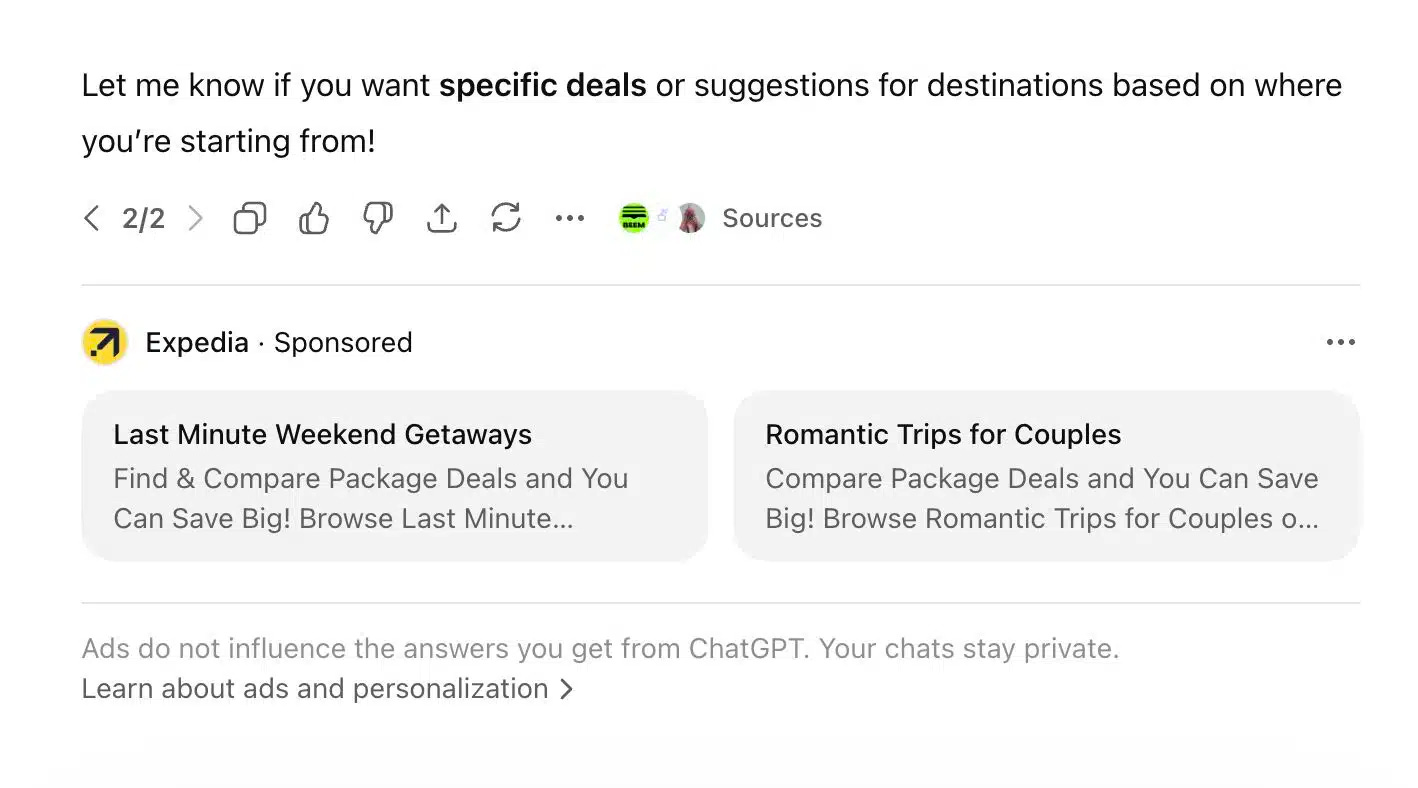
Image Credit: Searchengineland.com
Early Indicators of a More Dramatic Change
This seems like just a small part of the direction I see us heading with artificial intelligence. Right now, we are at the peak of increasing engagement and adding users (at least in the United States). However, we could soon be headed in a different direction: now that you use it, and now that you like it, now we have to start giving our investors a return on their capital.
ChatGPT recently began rolling out ads; Gemini and Perplexity have already implemented advertisements; and Meta AI plans to do so in February (with Claude as the ad-free outlier, solely focusing on subscriptions). What started as a “last resort” for these platforms is now a reality.
The question is, what extent will these advertisements influence responses? What data/privacy concerns might come of it? How will advertisements impact the churn rates and customer lifetime value of users? Only time will tell, but if I had to guess, we’ll learn a lot very quickly.
Where Do We Go Next?
Television introduced ads into the viewership experience via commercials. The Internet brought digital advertisements directly to your fingertips. The rise of social media influencers blurred the lines between advertising and purchasing via platforms like TikTok Shop and Instagram Reels Product Tagging. Who knows how ads will embed themselves into the user experience across AI applications.
As LLMs continue to become more powerful, more intuitive, and easier to integrate within legacy systems, one thing’s for sure: there’s going to be a need to pay for it.
Where do you see the industry headed next? What proprietary business models might we see as AI integration rates continue to skyrocket?
Relevant Links
Email: bryanhanleyvc@gmail.com
LinkedIn: https://www.linkedin.com/in/bryan-stanley-hanley/
Lovable Website: https://bryan-hanley.lovable.app/