
The Second Layer in Space
SpaceX democratized access to space travel, opening the door for commercialization. This commercialization has created a major second-layer opportunity, and these startups are taking advantage.

The Impact of SpaceX
For decades, space was reserved for government-affiliated organizations, acting as a sort of “geopolitical theatre” to demonstrate navigational capabilities and power. Commerce wasn’t the goal; dominance was, and only the strongest countries in the world had the capabilities of space travel. From Sputnik in 1957 to 2010, fewer than 50 companies globally had any meaningful commercial space activity. Since 2010, that has certainly changed quite a lot.
This change primarily came from SpaceX, which had its first successful commercial launch in September 2008 after the fourth attempt of its Falcon 1 rocket. However, the most monumental shift came from its Falcon 9 Launch in 2017, representing the first successful reuse of a rocket.
This successful reuse not only meant a major shift in how we travel to space but also demonstrated that space travel could be financially viable. What was traditionally reserved for major governments was now accessible for startups - even a startup of $5 million could put a satellite into orbit.
Space tech companies raised $8.17 billion in 2025, a 154% increase from 2024. Startups are realizing the economic potential of space, and investors are taking advantage, particularly within defense and AI. SpaceX enabled a data layer that opened a window of opportunity for space innovation, creating a major second-layer opportunity. And it’s these opportunities that I’m most excited about from an investment perspective.
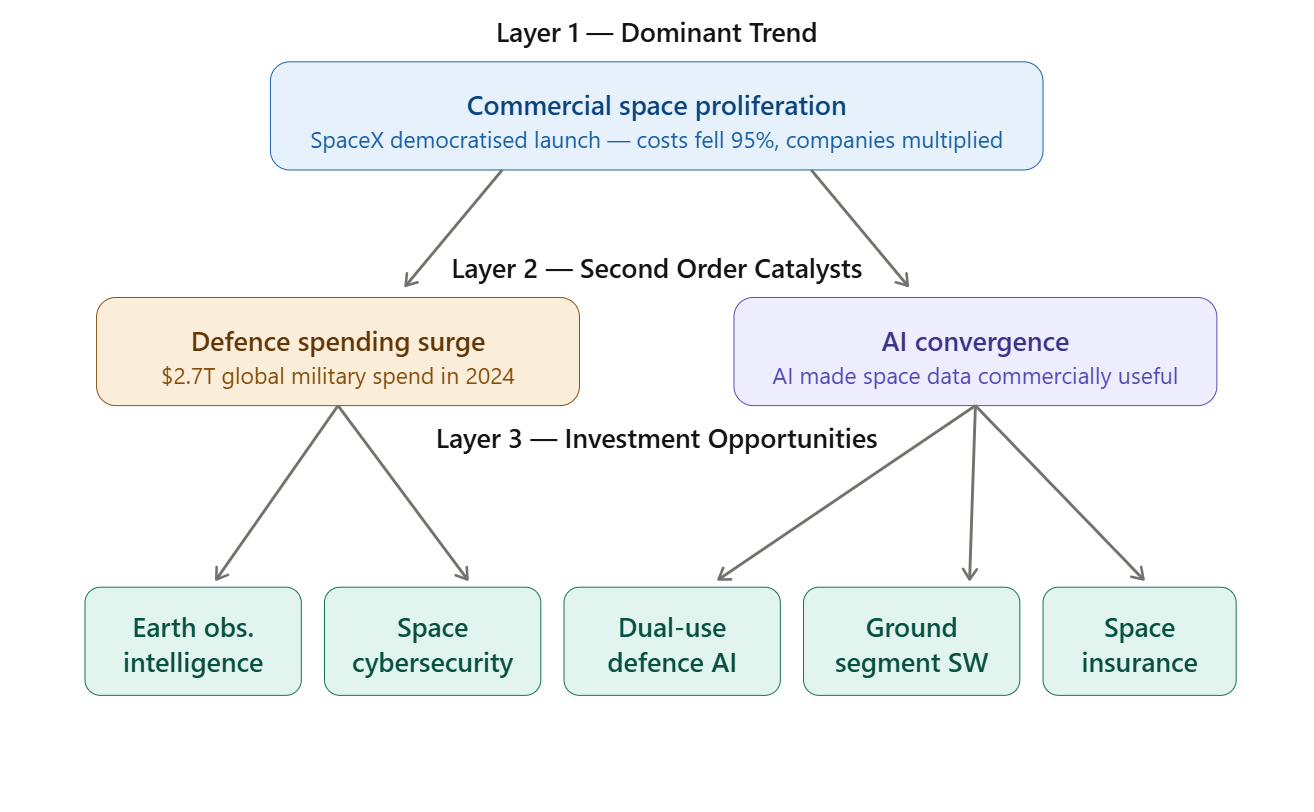
Space Startups Aligned with the Second Layer Thesis
As I’ve continued to deploy my Second Layer framework across a variety of sectors, space remains one of the most lucrative and exciting industries, with some incredible founders building within it. Here are a few startups building within the space sector in alignment with the Second Layer Approach that have all demonstrated significant growth and potential, as evidenced by tremendous progress and impressive valuations:
Aalyria
Aalyria, which recently raised $100 million to reach a valuation of $1.3 billion, provides a network orchestration platform that enables stronger wireless internet connectivity for government defense agencies, satellite operators, and commercial aerospace companies by mitigating network errors caused by weather disruptions, atmospheric interference, and shifting military priorities. There are over 11,000 satellites in orbit - when data travels across a satellite constellation, it must move across these various satellites, which are moving at 17,000+ mph, all in different directions. Spacetime reconfigures an internet constellation’s antenna to the path of least resistance, helping ensure critical data is best routed for priority missions.
Privateer Space
Privateer Space led a Series A of $56.5 million, led by Aero X Ventures, in May of 2024. Founded by Apple Co-founder Steve Wozniak, CEO Alex Fielding, and Dr. Moriba Jah, Privateer Space provides real-time debris and collision-risk visualization to commercial and government clients through their Wayfinder platform (which operates as the “Google Maps” of space). Wayfinder enables space object tracking, anomaly detection, space traffic management, and more. As mega-constellation proliferation (the rapid development of hundreds to thousands of small, low-cost satellites in Low Earth Orbit), created orbital congestion, Privateer Space is providing the technology to help operators navigate the crowded space these constellations occupy.
Orbit Fab
Orbit Fab closed a $28.5 million Series A round in April of 2023, led by 8090 Industries, alongside $21 million in defense contracts. This brings their total venture funding to over $45 million. Orbit Fab’s mission is to build the in-space propellant supply chain through their refueling interface, RAFTI, which enables on-orbit refueling with a built-in cooperative docking capability. RAFTI eliminates the need for single-use spacecraft - its refuel design enables spacecraft to get to orbit faster and do more while they’re there, minimizing the supplemental weight associated with traditional fill and drain components. As satellite constellation growth made replacing satellites more expensive than extending their lives, Orbit Fab provided the technology to make this happen, demonstrating direct alignment with the Second Layer thesis.
Unseenlabs
Unseenlabs was founded by three brothers, Clément, Jonathan, and Benjamin Galic, and focuses on space-based radio frequency detection for Maritime Domain Awareness (the effective understanding of anything associated with the global maritime domain, which includes vessels, cargo, people, or infrastructure, and how these could impact security, safety, and the environment). Unseenlabs has raised €120 million, which includes a €85 million Series C round in February 2024. Their Second Layer alignment is clear: satellite proliferation created the infrastructure that enabled the detection of Radio Frequency signals from orbit, which exposed a gap in massive maritime surveillance. Unseenlabs built a constellation of shoe-box-sized satellites that detect ships even when they turn off their AIS (Automatic Identification System) transponder. This provides an additional layer of safety and security, enabling governments and organizations to geolocate any vessel at sea regardless of whether it wants to be found, in any weather, day or night.
Note: The views expressed in this article are my own and are intended for informational purposes only. Nothing here constitutes financial or investment advice. Venture capital involves significant risk, and all investment decisions should be made in consultation with a qualified financial professional.
Relevant Links
Email: bryanhanleyvc@gmail.com
LinkedIn: https://www.linkedin.com/in/bryan-stanley-hanley/
Lovable Website: https://bryan-hanley.lovable.app/